
More Funding Options, Less Dilution: A New Open Resource for Hardware Startups – CapStackCompass.ai
Why the next wave of deeptech and hardware innovation requires smarter capital — and where to find it using CapStackCompass.ai


Between rising interest rates and a pullback in climate-focused grants from the US government, and a venture landscape that’s harder than ever to navigate, builders are rethinking how they fund their companies. Many are getting more creative about where capital comes from — and more protective of how much equity they give up in the process.
We think that’s a good thing.
Why Hard Tech Needs More Than Venture Capital
Climate tech is inherently driven by hardware. For startups tackling physical challenges — batteries, energy systems, resilient infrastructure, EV fleets — venture capital alone isn’t enough. Equity makes sense for early hiring and R&D, but as companies scale and start spending on physical assets like inventory, equipment, and project deployment, financing those needs through equity alone gets expensive fast.
The good news: the non-dilutive funding landscape has been growing. Startups now have access to a broader set of capital instruments — revenue-based financing, equipment leasing, asset-backed loans, project finance, and early-stage private credit — especially as data and underwriting tools improve. These alternatives are gaining traction in capital-intensive sectors where traditional equity isn’t always the best fit.
Early credit lines can also help startups build credit history early, establish lender relationships for future rounds, and explore creative structures like off-balance-sheet leasing (not unlike what’s been used in residential solar, batteries, and auto manufacturing). Some companies are even using non-traditional financing to boost sales through approaches like benefit-now-pay-later.
But the challenge isn’t just supply. Many early-stage hardware startups struggle to meet the revenue thresholds or asset maturity requirements that traditional lenders look for. On the flip side, many capex-focused investors are still figuring out how to underwrite earlier stage companies and climate infrastructure. Building relationships with credit providers earlier — and understanding what they need to see — matters.
We think about this as an “Escalator of Impact” — as a company matures, its capital stack should evolve with it, layering in grants, venture capital, customers, partners, lenders, and eventually off-balance-sheet structures:
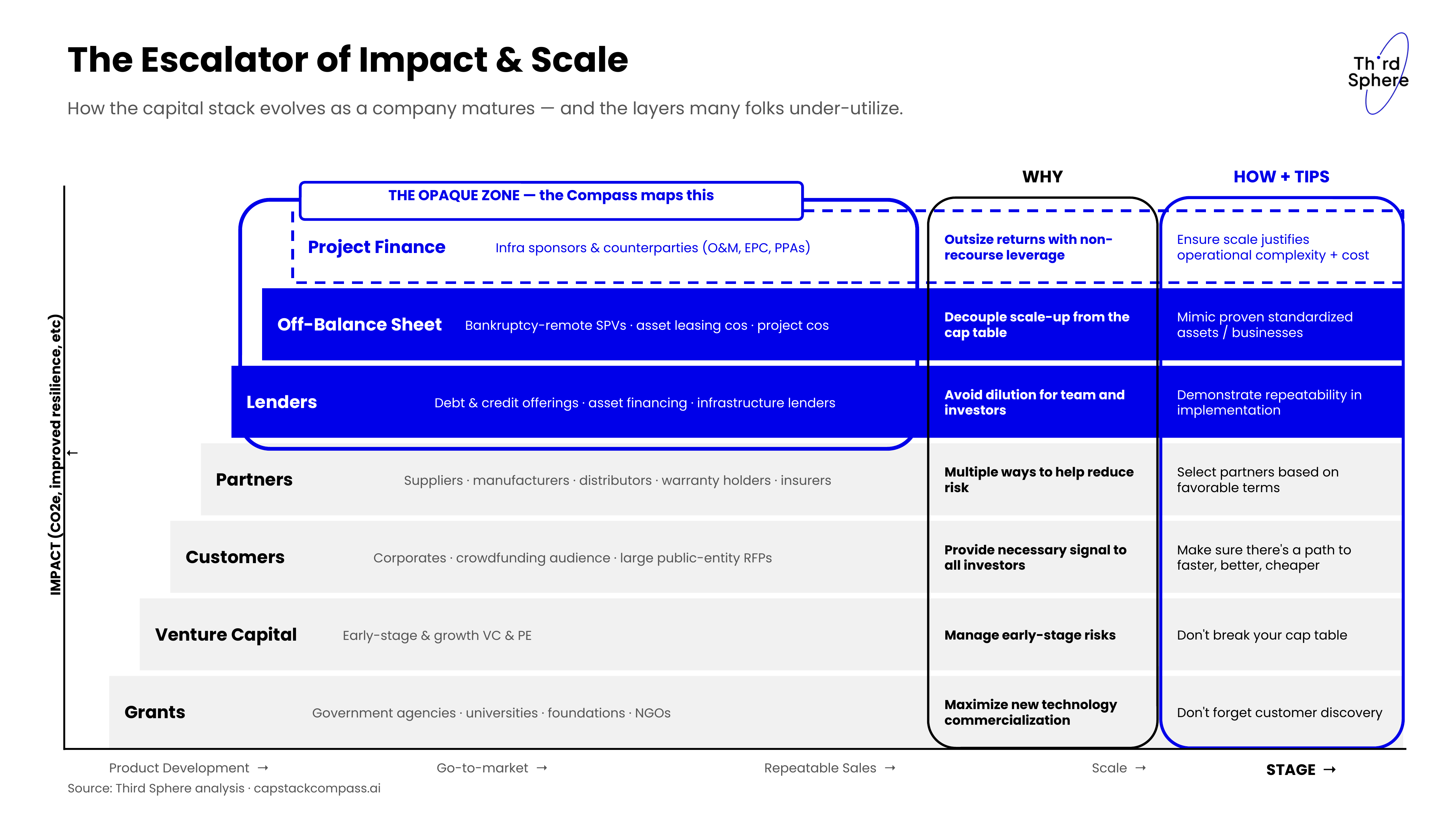
Each layer in the stack serves a different function — and the synergies go both ways. Lenders and partners highlighted here benefit from marketplace discovery, brand building, and early relationships with startups. Founders benefit from a roadmap that shows what capital is available at each stage and what it takes to access it.
What can unlocking alternative capital look like?
Building relationships with capital providers earlier on
Securing grants and customer commitments that can be used in underwriting
Securing partner commitments that provide cashflow flexibility
Securing a first loan and starting to build credit history for subsequent loans
Having a path to off-balance-sheet leasing structures — not unlike those used in residential solar, batteries, and auto manufacturing
Mapping out how non-equity options can unlock sales and navigate financing that turns products into services (XaaS)
We’ve written about this at length in our Speedstrap Playbook — a framework for how climate founders can build real traction while staying capital-efficient. One of the core principles: using non-dilutive capital in smart ways to extend runway, avoid unnecessary dilution, and create leverage for better fundraises (Part 2 here). This database was built to help founders do exactly that.
Introducing the Capital Stack Compass
Despite a growing wave of grants, loans, and new climate finance programs, securing the right capital often comes down to who you know. We wanted to change that.
The Capital Stack Compass is an open database of nearly 300 lenders and non-dilutive capital providers — from equipment leasing to project finance to asset-backed lending — designed to help founders and investors navigate the funding landscape more effectively.
It’s live at capstackcompass.ai. We gave it its first public demo at Edge Esmeralda’s demo day this week to get folks’ input.
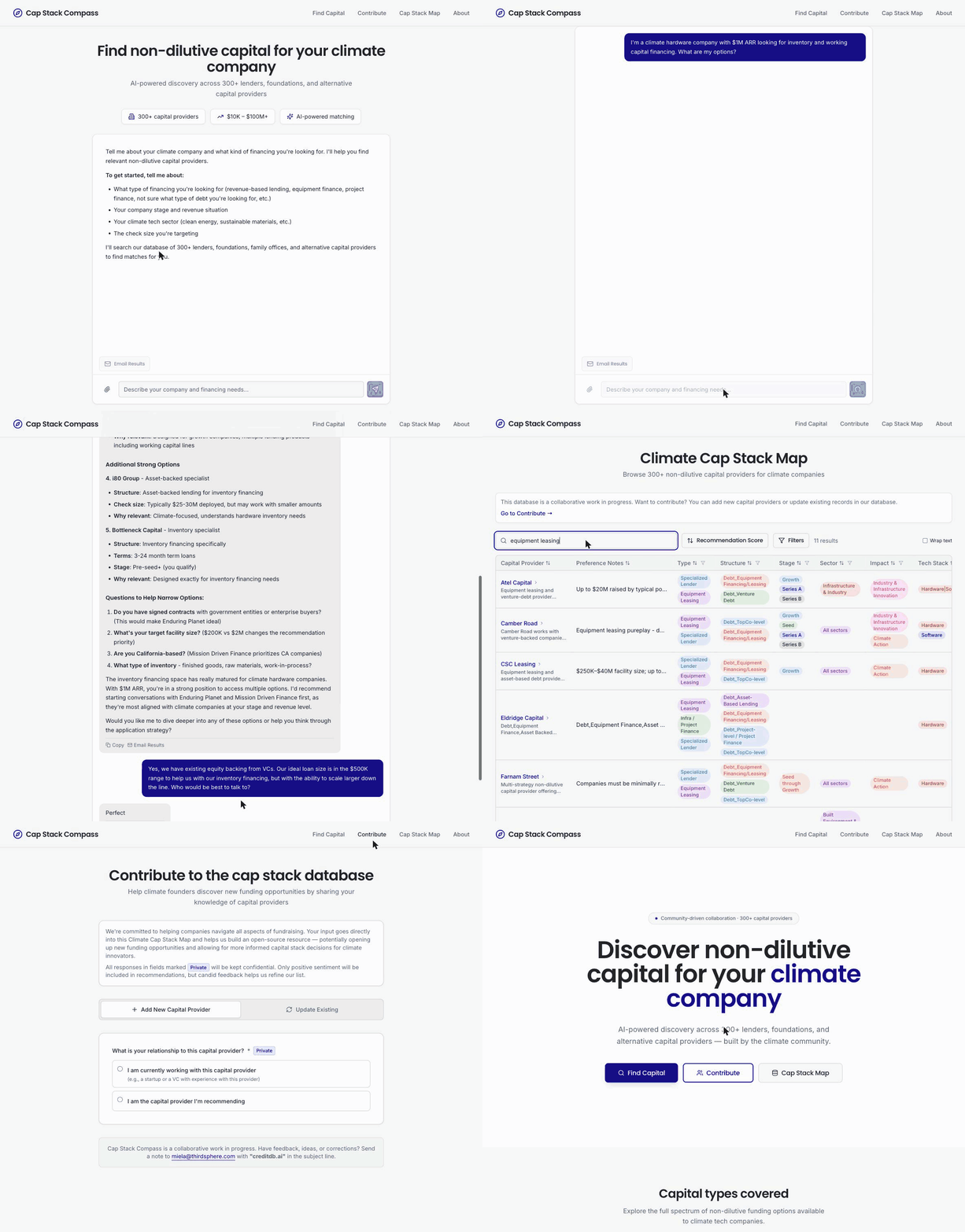
The tool includes:
A searchable map of capital providers (explore the map)
An AI-powered chatbot that matches founders with relevant lenders based on stage, sector, and financing needs (try it at /discover)
The ability to add, update, or flag provider information directly through the /contribute page
A few things worth noting:
No origination fees, no referral fees. This is a community resource, not a brokerage.
No ratings or rankings. Quality signals come from verified working relationships — when founders and investors confirm they’re actively working with a provider, that provider naturally surfaces.
Open and collaborative. We’re building this with help from many collaborators — the more people contribute, the more useful it gets.
Personal data stays private. All contributors, capital providers, and capital seekers data and contact information remains private. We may have opt in for contact sharing in the future but for now this is just an organization level discovery layer.
Shout-out to Daniel Kriozere and the many other awesome contributors who’ve helped shape this — Kim Dang (Planet A Ventures), Alec Turnbull, Arvind Vermani (Perl Street), and the business student team at Berkeley Haas who helped with research, cleanup, and classification. This is what a community resource actually looks like in practice.
What Founders Have Said Based on Connections Made
“100% pragmatic, respectful of founders’ time and challenges. Would recommend the team to any startup aiming to start on their campus.”
“Supportive, patient, sends referrals, overall an engaged and interested partner.”
These are the kinds of experiences we want to make easier for more founders to find.
A First Look at What’s Inside
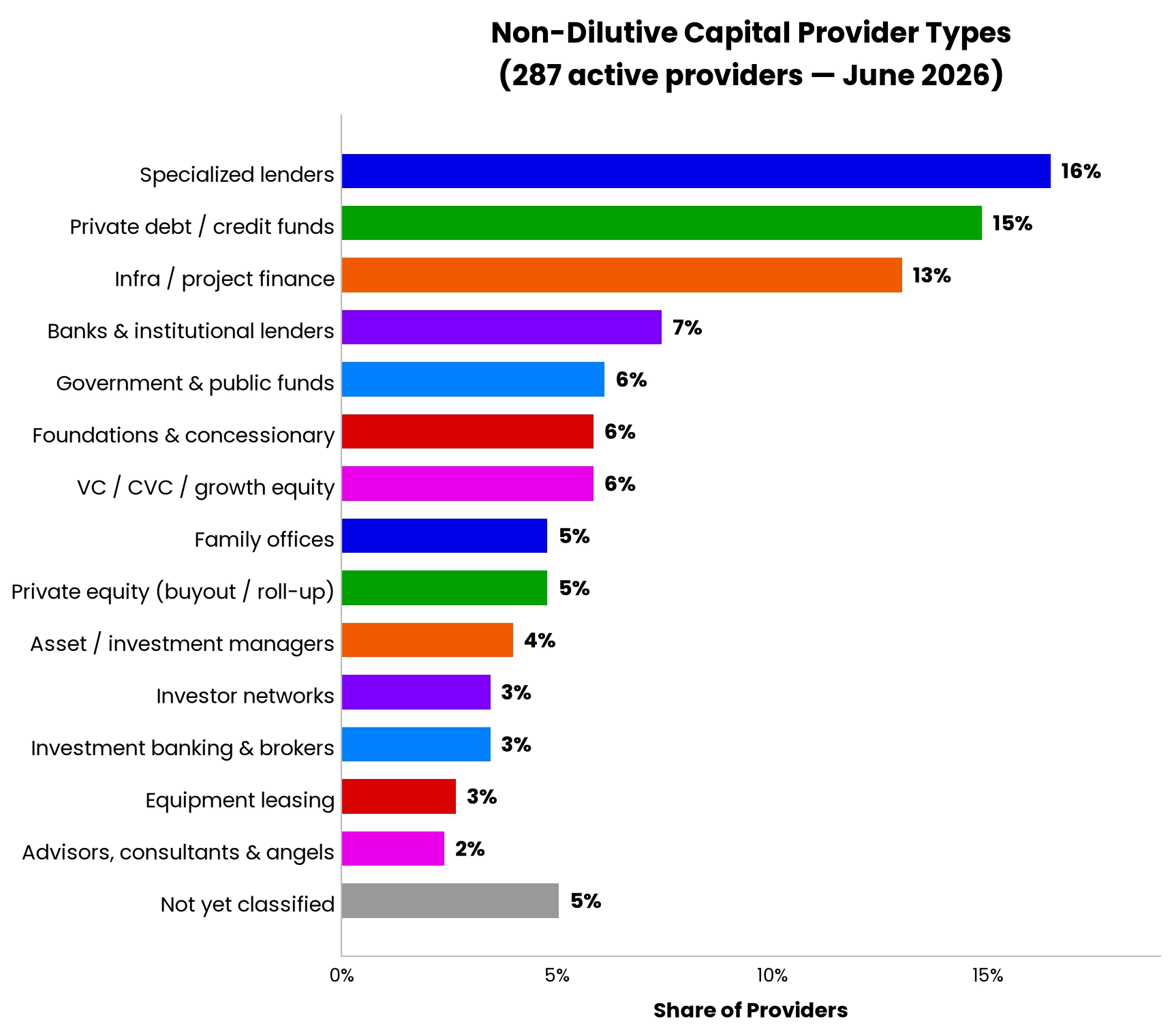
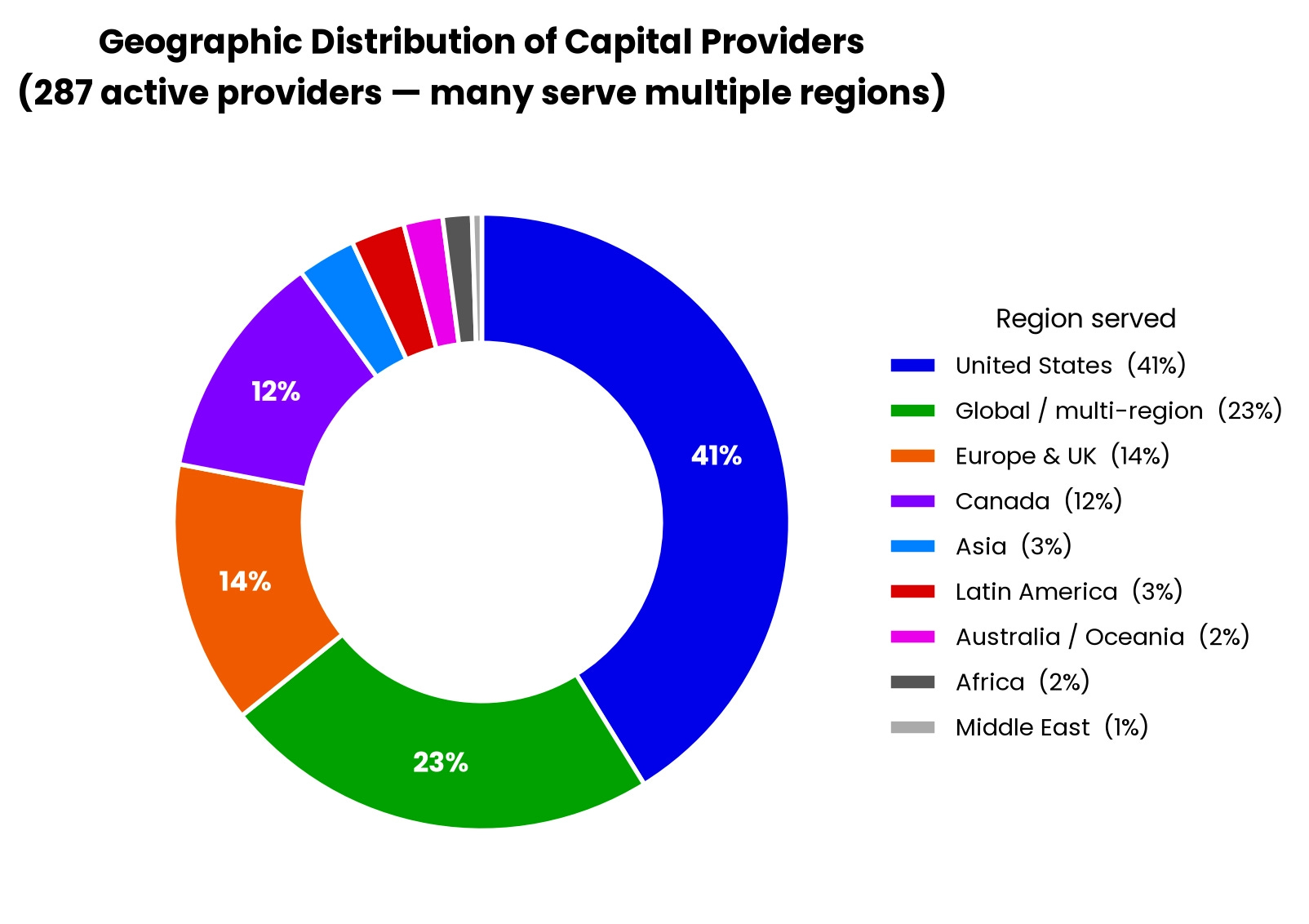
The current version includes nearly 300 active capital providers (287 as of June 2026, after a spring de-duplication pass) — a mix of traditional and non-traditional lenders and investors. Specialized climate equipment lenders, traditional banks with growing climate practices, private debt and credit funds, infrastructure and project finance players, family offices, government programs, and more.
A breakdown of what’s in the database so far:
What’s Next
We’re inviting all climate stakeholders — founders, funders, researchers, and ecosystem builders — to help expand this database, refine filters, and flag what’s missing.
The current version is live at capstackcompass.ai. If you’d like to contribute leads, update information, or share feedback, you can do that directly through the /contribute page or reach out to us.
Our standard for inclusion: We want to surface providers who are actually executing deals, not just talking in the space. The goal is to keep this as actionable as possible.
Come Build This With Us
We’ve been writing about (previously on medium, now on substack), and coaching startups on how to access non-dilutive funding options for nearly a decade and have met many investors along the way. Through our venture funds, we’ve piloted our own asset finance platform and helped incubate Perl Street so founders could finance next-generation distributed infrastructure. We’ve found ourselves advising on credit and non-dilutive capital in dozens of one-off conversations — and wanted to take everything we’ve learned and put it into something open and reusable.
The way we fund climate innovation needs to evolve as fast as the climate itself is changing. Founders deserve more than one playbook. By opening up access to non-dilutive funding and shedding light on under-the-radar investors, we want to support capital stacks that actually work for climate tech.
If you believe in scaling impactful solutions without unnecessary dilution — come build this with us.
Read more: Speedstrap Playbook Part 1 | Part 2
Written by Miela Mayer — Climate Tech @ Third Sphere.
 | A guest post by
|
 | A guest post by
|